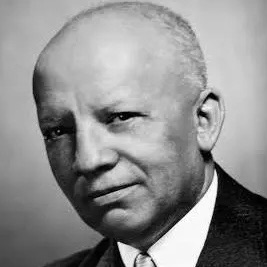
Today is February 1, and that marks the beginning of Black History Month. It is a month to celebrate the accomplishments of Black Americans in the United States, and ensure our past, no matter the horrors, isn’t forgotten. Due to the racial climate in which this country was founded, the history of Black Americans has not always been accessible, and when it was, not always accurately told. Carter G. Woodson made it his life’s mission to ensure Black History was permanently woven into the fabric of America.
In February 1926, historian Carter G. Woodson established “Negro History Week.” Woodson believed that Black people should be proud of their heritage and that every American should be made aware of Black people’s accomplishments. He chose the second week in February to coincide with the birthdays of Abraham Lincoln (February 12) and Frederick Douglas (Feb 14).
Woodson being barred from attending American Historical Association conferences led him to believe there was little interest in Black history by white historians. He believed the impact of contributions made by Black people were “overlooked, ignored, and even suppressed by the writers of history textbooks and the teachers who use them.” He created a separate institutional avenue to study and preserve our collective history. With funding aid provided by philanthropic foundations, Carter G. Woodson established the Association for the Study of Negro Life and History in 1915 in Chicago, Illinois. Its mission was the scientific study of the “neglected aspects of Negro life and history.” In 1916, he founded the scientific journal, The Journal of Negro History, which is still operating under the name The Journal of African American History.
As early as the 1940’s, three decades before it was officially established, pockets of Black people in West Virginia, where Woodson often spoke, had begun to celebrate Negro History Month. By the 1960’s in Chicago, cultural activist Fredrick H. Hammaurabi began celebrating Negro History Month as well. This, along with the influence of young scholars urging Woodson’s association, The Association for the Study of Nego Life, to acknowledge Negro History Month, led to it being recognized by the Association in the late 1970’s (Source). It was officially recognized as Black History Month in 1976 under President Gerald Ford’s administration.
In addition to what is now Black History Month, Carter G. Wooden also published books on Black History to include, but are not limited to, A Century of Negro Migration (1918), The Education of the Negro Prior to 1861 (1919), The History of the Negro Church (1921), The Negro in Our History (1922) l, The Miseducation of the Negro (1933), and African Heroes and Heorines (1944) (Source).
Today, now more than ever before, it is crucial that we preserve the history of our culture. Libraries are losing funding, books are being banned, and some schools are losing their libraries altogether. We are in a digital age where Alternative Intelligence technology is being used for nefarious purposes like spreading misinformation and disinformation with minority populations, namely Black people, among the most vulnerable. Write, record, and archive your personal family history as well as current events by any means necessary to guarantee that future generations have Black history from our perspectives.
Happy Black History Month!



 Southern Diva
Leave a comment